L017 👨🍳🥕👨🌾 Train Your Ear: 2nd bite
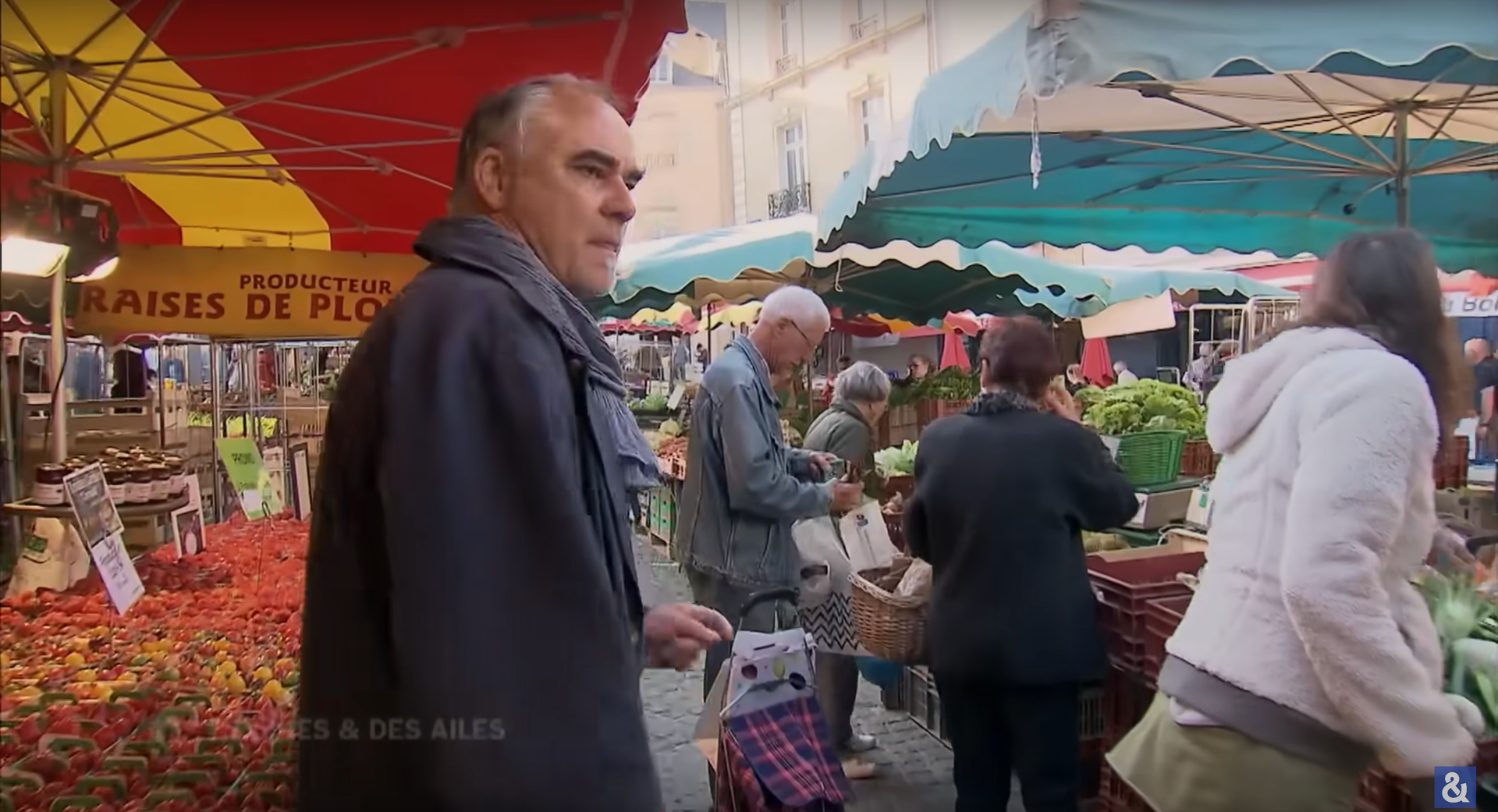

🎯 Purpose → By the end of this page, this part of the video will make sense:
How we're going to achieve this: 3 simple steps
There are three challenges to understanding real spoken French:
- 👂 Knowing the words by ear, not just by eye
- 🕵️ Picking them out in the uninterruptedflowofsoundswecallsentences
- 🚅 Keeping up with the natural TGV-like pace of spoken French.
So I've divided this page into three parts, each training one of those three skills.
👂 Skill #1: Know The Words By Ear

Try the following Ear Trainers, and keep in mind: you're not supposed to get them right on the first go.
So why are the answers hidden?
They're hidden to help you:
- be active and fully present, so your energy-conscious brain can’t just coast on autopilot.
- focus on one thing at a time: first the sound, then the spelling, and finally the meaning. Brains absorb more this way than by skimming.
- retain what you learn — if you always follow the GPS, you’ll never learn to navigate for yourself. In other words: giving the answer = stealing the learning.
🗣️👂What you hear: Honest Spelling
le-shèf
🔡📜 What we write
le chef
🇬🇧🇺🇸 What it means
the chef OR the boss/leader
🗣️👂What you hear: Honest Spelling
le-pre-myé
🔡📜 What we write
le premier xx
🇬🇧🇺🇸 What it means
the first xx
🗣️👂What you hear: Honest Spelling
du-pre-myé
🔡📜 What we write
du premier xx
🇬🇧🇺🇸 What it means
of the first xx
🔡📜 What we write
un restaurant
🇬🇧🇺🇸 What it means
a restaurant
🗣️👂What you hear: Honest Spelling
du-pre-myé-rè-sto-rã
🔡📜 What we write
du premier restaurant
🇬🇧🇺🇸 What it means
of the first restaurant
🗣️👂What you hear: Honest Spelling
gas-tro-no-mik
🔡📜 What we write
gastronomique
🇬🇧🇺🇸 What it means
fine-dining / gourmet
🗣️👂What you hear: Honest Spelling
byo
🔡📜 What we write
bio
Short for "biologique".
🇬🇧🇺🇸 What it means
organic
(food, farming, production...)
👨🏻🏫:
🌍 Beyond Translation: bio
🗣️👂What you hear: Honest Spelling
le-mor-bi-yã
🔡📜 What we write
le Morbihan
🇬🇧🇺🇸 What it means
🗣️👂What you hear: Honest Spelling
du-mor-bi-yã
🔡📜 What we write
du Morbihan
🇬🇧🇺🇸 What it means
Feeling frustrated? Click here.
👉 Next step: once you can catch most words in the Ear Trainers, move on to the next part.
🕵️ Skill #2: Pick words out
Time to go from isolated words to flowing French sentences. Let’s sharpen your ability to hear word boundaries in the middle of real speech.
🚴 The Training Wheels Problem: Why spoken French is hard to decode even when you know the words.
When we write, we add neat little spaces between each word. That makes it obvious where one word ends and the next begins.
But those spaces are a mirage.
Whenwespeakitsoundsmorelikethis so it's hard to tell words apart.
(Fun question — glance at this: togetherintrouble. Did you read together in trouble or to get her in trouble ? 😉)
To make things worse, we French speakers love to blur the boundaries between words.
Here are some examples where the exact same sound could mean different things:
- sé-té...
- c'était... (it was...)
- c'est tes... (it is your...)
- je-vé-la-vwar
- je vais la voir (I'm going to see her)
- je vais l'avoir (I'm going to have it)
- je-vou-lé...
- je voulais... (I wanted to...)
- je vous les... (I [verb] to you)
- õ-né-dé...
- on est des... (we are some...)
- on aidait... (we were helping...)
Even native speakers like me rely on context to decode this blur.
So one of the big challenges in understanding spoken French is Word Detection: figuring out where words start and end.
Teachers are aware of that so they often. Pause. Between. Each. Word.
It's. Well. Intentioned. But. Misguided.
It's like learning to ride a bike with training wheels. It makes you feel good... until you try a real bike and feel overwhelmed by the balancing.
Because training wheels prevent you from training balance.
And balancing is such a central skill that it's almost like you're starting from scratch.
The same goes for listening.
That slow, word-by-word speaking style gives away the word boundaries.
So it prevents you from training your Word Detection skills.
That's why I created Syllable Spacing:
- 🐌 It's slower than natural speech, so you have more time to think.
- 🔪 But the pauses are between syllables, not words — so you still have to figure out where words start and end.
It's like a balance bike — a bike with no pedals that lets children focus entirely on balancing first. Makes it easier to transition to a real bike, because you've already mastered the hardest part.
Truth is, training wheels still have their place. They help you get comfortable with pedalling and steering. But they work much better in tandem with balance bikes. So here you'll get both Syllable Spacing and Teacher Style recordings.
Soon you'll be riding in the Tour de France. No training wheels — and hopefully no doping 😜
🎯 Your goal:
- Catch as many words as you can in 'Syllable Spacing'.
- Confirm them with 'Teacher Style'.
🔁 Go back and forth as many times as needed to connect the dots between the two recordings.
Can't recognise some of the words in Teacher Style? No problem. Click here to train your ear on individual words again. You've got this 🙌
😩 Stuck? Take a break — go for a walk without your phone, have a drink... And come back with a fresh mind.
👉 Only move on once you can catch every word in Syllable Spacing.
🚅 Skill #3: Get Up To Speed

Now that you can catch every word in Syllable Spacing, let’s see how that maps onto real French — in the actual clip.
🐢 Slow and steady wins the race, so take your time:
Watch the video at 0.5x speed, over and over until you can catch most of it, then gradually increase the speed.
- Click the gear icon ⚙️ (bottom-right corner of the video player)
- Click Playback speed
- Select 0.5×.
📜 Transcript
Narrator:
Gilles Le Gallès, le chef du premier restaurant gastronomique bio du Morbihan,
🇬🇧🇺🇸 Direct Translation
Narrator:
Gilles Le Gallès, the chef of the first organic gourmet restaurant of the Morbihan,
🇬🇧🇺🇸 Natural Translation
Narrator:
Gilles Le Gallès —the chef at Morbihan's first organic fine-dining restaurant
Only move on once you're happy with your progress.
This isn't a sprint.
Be French: take your time, savour the process. 🍷
- If you don't understand enough in the video, go back to Syllable Spacing.
- If you don't understand enough in Syllable Spacing, go back to Teacher Style.
- If you can't catch every word in Teacher Style, train your ear on individual words again.
- And if none of those help, give yourself a break. Take a walk, a nap, a drink. Come back with a fresh mind.
👉 Now that you understand the clip, take a moment to savour your progress and revisit the earlier bites with fresh ears.
📜 Transcript
Narrator:
Il est 8h et, comme chaque mercredi, Gilles Le Gallès, le chef du premier restaurant gastronomique bio du Morbihan,
🇬🇧🇺🇸 Direct Translation
Narrator:Il est 8h, et comme chaque mercredi,
It's 8 o'clock/8 in the morning, and like each Wednesday,
Gilles Le Gallès, le chef du premier restaurant gastronomique bio du Morbihan,
Gilles Le Gallès, the chef of the first organic gourmet restaurant of the Morbihan,
🇬🇧🇺🇸 Natural Translation
Narrator:
It's 8 o'clock/8 in the morning, and like each Wednesday, Gilles Le Gallès —the chef at Morbihan's first organic fine-dining restaurant
👉 Ready for the next bite-sized breakthrough?